
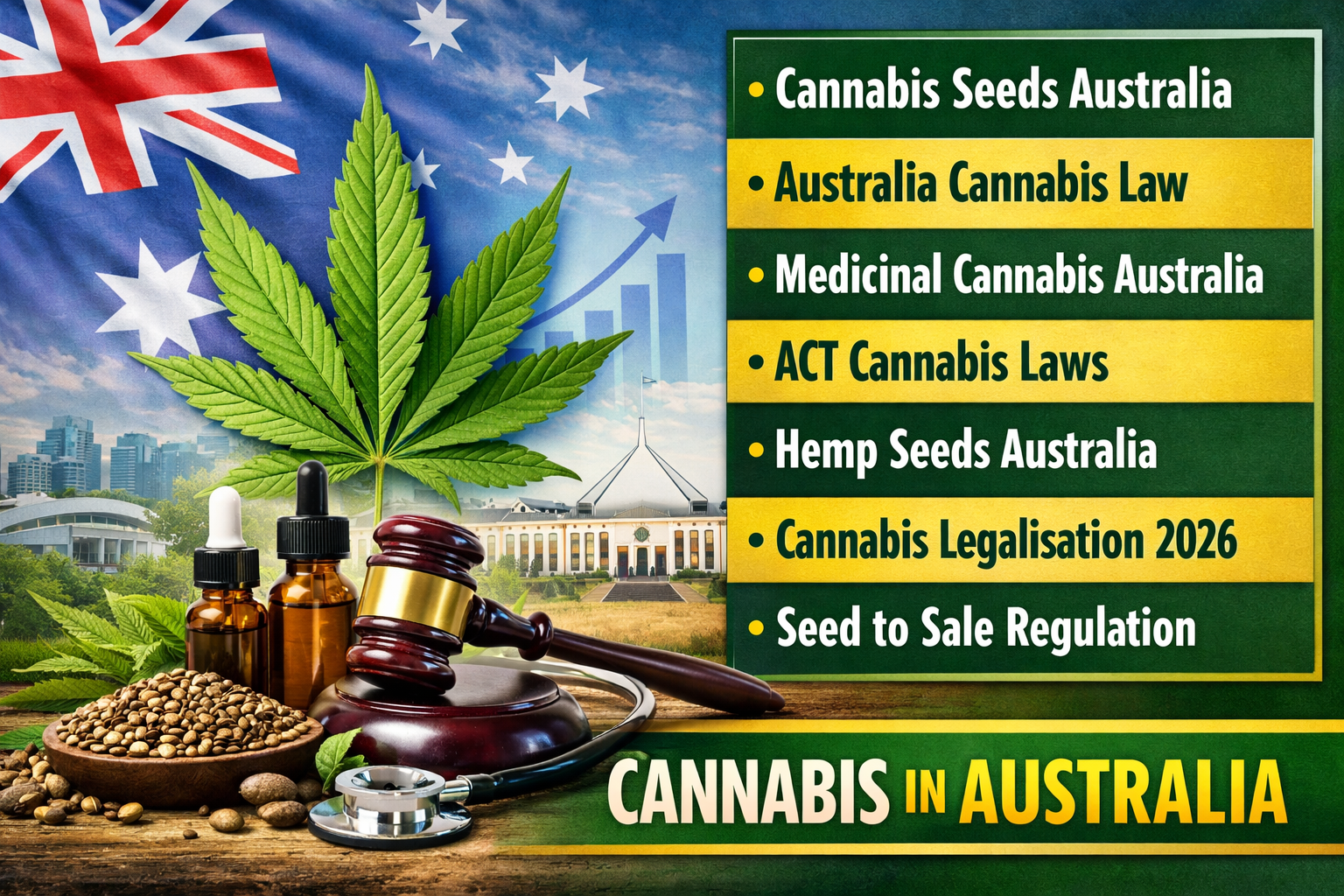
And honestly? That’s fair. The rules are different by country, different by state, and they’re changing in public debate faster than most people can keep up with.
This post breaks it all down in plain English, using a conversational Q&A format so you can scan for the exact question you’re asking right now.
I’ll also connect the dots on how the United States has influenced cannabis reform across the West—Canada, Europe, and increasingly Australia—while keeping the focus on the topic people keep Googling: cannabis seeds Australia.
Important: This article is general information, not legal advice. Cannabis laws can change, and enforcement can vary.
For legal clarity, check official government sources linked below or speak to a qualified lawyer in your state or territory.
Quick Answers (for Google snippets & AI answer engines)
- America’s state-by-state legalisation model has influenced Canada, parts of Europe, and the global conversation by showing real tax revenue, regulated supply chains, and mainstream adoption.
- Australia legalised medicinal cannabis nationally in 2016 under a federal licensing framework, but adult-use cannabis is not legal federally.
- ACT has personal possession and limited home grow allowances under local law, but federal law still applies and sales remain illegal.
- “Cannabis seeds in Australia” is a high-intent search because many people expect law reform, want genetic options, or want clarity on what is legal now.
- Importing viable cannabis seeds can be illegal without permits, and state/territory laws can also apply. Always verify with official sources before taking any action.
Want one Australian-focused discussion about possible future reform? Here’s a local read:
Cannabis Legalisation in Australia 2026 (KoalaKush)
.
Transparency note: I can’t directly access or “crawl” that page from here in real time. If you paste key excerpts you want cited, I can quote and attribute them precisely.
In this article, I include it as relevant further reading alongside official and academic sources.
Q: How exactly is America influencing cannabis legalisation across the West?
The US influence is less about one federal law (because federally, cannabis is still illegal in the US) and more about proof by example.
Over the last decade, many US states built regulated markets that other countries watched closely—especially on public health rules, product testing, tax revenue, and how to handle home grow.
Q: What’s the “US model” that other countries keep copying?
The US model is often described as state-by-state legalisation:
- States vote or legislate adult-use cannabis rules.
- States license growers, manufacturers, and retailers.
- States set testing, packaging, and advertising restrictions.
- States collect taxes and report the results (revenue, enforcement costs, etc.).
For quick context, the National Conference of State Legislatures (NCSL)
tracks US medical cannabis laws, and it also tracks adult-use changes by state in related summaries.
As of recent NCSL reporting, dozens of states have medical programs, and many have adult-use legalisation.
Q: Why does US state legalisation affect Australia at all?
Because the US exports culture, policy ideas, and business patterns. That influence shows up in everyday conversations:
- Public opinion shifts after people see legal cannabis work “somewhere normal,” not just in theory.
- Medical legitimacy grows as more studies, clinical use, and real patient stories go mainstream.
- Regulation templates spread (testing labs, child-resistant packaging, seed-to-sale tracking).
- Economic arguments land harder when people can point to real government revenue data.
Q: What’s a real example of “proof by example” from the US?
Colorado is the classic reference point because it was one of the first states to build a full adult-use market.
Colorado publicly reports cannabis tax data via the
Colorado Department of Revenue.
Those kinds of transparent dashboards are persuasive in policy debates because they turn arguments into spreadsheets.
I remember my first visit to a legal dispensary in the US. What surprised me wasn’t the product menu.
It was how boringly “normal” the compliance felt—ID checks, purchase limits, and staff who sounded more like pharmacy retail than counterculture.
That normality is part of the influence. It changes the mental picture people hold.
Q: If America didn’t legalise federally, why did Canada and parts of Europe legalise anyway?
Great question—and it’s exactly where the US influence gets misunderstood.
The US didn’t “command” anyone to legalise. Instead, it helped make legal cannabis feel like a manageable policy choice rather than an unthinkable risk.
Q: How did Canada respond to the North American trend?
Canada legalised adult-use cannabis nationwide in 2018 under the Cannabis Act.
The official Canadian government portal is here:
Health Canada — Cannabis.
One detail Australians bring up a lot: home grow.
In Canada, federal rules allow adults to grow up to 4 plants per household (with provincial limits and exceptions).
That single rule has shaped countless debates in other countries about personal freedom vs. diversion risks.
Q: What about Europe?
Europe has taken multiple paths:
- Malta (non-profit cultivation clubs and limited home grow).
- Germany (adult-use reforms with home cultivation and clubs, with a strong public health focus).
- The Netherlands (longstanding tolerance policy plus regulated supply experiments).
Official European references change by country, so I recommend starting with:
EU Drugs Agency (EMCDDA)
for comparative policy analysis and data.
Q: Where does Australia stand right now on cannabis law?
Q: Is cannabis legal in Australia?
Adult-use cannabis is not legal federally in Australia.
Australia does have a national system for medicinal cannabis, and rules vary by state and territory for possession penalties and enforcement priorities.
Q: What changed in 2016 (and why does it matter for seeds)?
In 2016, Australia created a federal framework to license cultivation and production of medicinal cannabis.
The most reliable starting point is the Australian Government Department of Health and Aged Care content and the regulator pages, including:
- Therapeutic Goods Administration (TGA) — Medicinal cannabis
- Office of Drug Control (ODC) — Medicinal cannabis licensing
That framework matters because once a country builds a regulated cultivation system (even for medical), the public starts asking:
“If we can regulate it for patients, why can’t we regulate it for adults?”
That question often leads straight into curiosity about cannabis seeds, genetics, and home grow rules.
Q: What’s the ACT situation people keep talking about?
The Australian Capital Territory introduced local reforms that allow limited personal possession and cultivation under ACT law.
But sales remain illegal, and federal law still applies.
For official detail, start with the ACT Government information and updates, for example via:
ACT Government.
Here’s the simplest way Aussies describe it in real life: “You can grow, but you can’t buy.”
That awkward gap is one reason “cannabis seeds in Australia” keeps trending as a search query.
Key definition: Home grow means cultivating cannabis plants at home for personal use, usually with plant limits and rules about visibility and access by children.
Q: Are cannabis seeds legal in Australia?
This is the big one—and the honest answer is: it depends on what you mean by “legal,” what you plan to do, where you live, and whether seeds are imported or local.
It can also depend on whether seeds are viable, and how authorities interpret intent.
Q: What do people mean by “cannabis seeds”?
People usually mean one of these:
- Viable cannabis seeds (intended to germinate and grow into a cannabis plant).
- Non-viable “souvenir” seeds (often marketed as collectibles).
- Hemp seeds (commonly sold as food; these are typically non-viable for cultivation and regulated differently).
Key definition: Hemp usually refers to cannabis plants with very low THC (tetrahydrocannabinol).
THC is the main intoxicating cannabinoid. CBD (cannabidiol) is non-intoxicating.
Q: Can you import cannabis seeds into Australia?
Import rules are a major risk area. Australia regulates imports through federal law and permit systems.
A good starting point for import and border controls is the Australian Border Force and federal legislation pages:
Practical takeaway: If a website says “we ship cannabis seeds to Australia,” that does not mean the shipment is lawful, low-risk, or permitted.
Border screening and seizure are real possibilities, and penalties can be serious depending on circumstances.
Q: What about buying or possessing seeds inside Australia?
State and territory drug laws can treat seeds and cultivation-related items differently, and the bigger legal issue is often what happens next:
germination, cultivation, possession of plants, and supply.
Because rules vary and can be fact-specific, here’s a quick scanning table you can use as a “reality check” list of the common scenarios people ask about.
| Scenario people mean by “cannabis seeds Australia” | What’s usually at issue | Safer next step (non-legal advice) |
|---|---|---|
| Importing seeds from overseas | Federal import controls, permits, seizure risk | Check ABF guidance and get formal legal advice before attempting any import |
| Possessing seeds locally | State/territory drug laws, intent, enforcement priorities | Review your state/territory legislation and official guidance |
| Germinating seeds | Cultivation offences (often treated more seriously than mere possession) | Do not assume “personal use” equals “legal”; confirm local law first |
| Growing in ACT under ACT rules | Local allowances vs federal law conflict; sales still illegal | Read ACT Government info carefully and stay within local limits |
| Buying hemp seeds as food | Food standards rules; product type matters | Check FSANZ for hemp food rules |
Key fact: In Australia, legal medicinal cannabis access is generally handled through doctors and the TGA pathways (such as the Special Access Scheme).
That’s very different from “buy seeds and grow your own.”
If you’re seeking relief for a health issue, start with the official TGA explainer:
TGA — Medicinal cannabis guidance documents.
Q: Why are Australians searching “cannabis seeds in Australia” so much right now?
I hear versions of this question constantly, usually from people who aren’t trying to be reckless. They just want clarity.
In everyday terms, the search surge is driven by a few repeating themes:
- Expectation of reform: People see legal markets overseas and assume Australia will follow.
- Home grow curiosity: The ACT conversation made “home grow” feel more real to many Aussies.
- Genetics talk is mainstream now: Even casual users talk about strains, terpene profiles, THC/CBD ratios.
- Medical access questions: Some patients feel clinic costs are high and wonder about alternatives.
- Cost of living pressure: People compare legal prices overseas to black-market uncertainty at home.
There’s also a cultural angle. Australia has a strong gardening and “grow your own” spirit.
I’ve had chats at barbecues where someone’s proud of their tomatoes, then quietly asks about cannabis seeds like they’re discussing a secret chilli plant.
Same vibe: curiosity, pride, and a desire to do it properly.
Q: What’s the step-by-step “influence pipeline” from America to Australia?
If you want a simple chain of cause and effect, here’s how it often goes:
- US state legalisation normalises the idea (people see regulated stores, not street deals).
- Canada legalises nationally, giving a close “peer country” example with federal rules.
- Europe tests multiple models (clubs, home grow, regulated supply pilots).
- Australian debate shifts from “should we?” to “what model would we use?”
- Search interest spikes in practical topics like “cannabis seeds in Australia,” “home grow rules,” and “what’s legal in NSW/VIC/QLD.”
Q: What does “policy diffusion” mean in plain English?
Policy diffusion means governments copy ideas that appear to work elsewhere—especially if there’s data and a clear regulatory template.
Cannabis policy is a textbook example: testing standards, packaging warnings, and seed-to-sale tracking often follow patterns pioneered in early legal markets.
Clear definition: Seed-to-sale is a tracking system used in legal cannabis markets that records product movement from cultivation to retail sale to reduce diversion to illegal markets.
Q: If Australia legalises adult-use cannabis, what might happen with cannabis seeds?
No one can promise a date or a final model. But we can talk about what typically happens in Western legal markets.
In most places that legalise adult use, seeds become regulated through one or more channels:
- Licensed retail: Seeds sold by licensed stores with age verification.
- Licensed producers: Seed production governed by quality, labeling, and testing rules.
- Home grow allowances: Seeds permitted for limited personal cultivation, often with plant caps.
- Import controls remain: Even legal countries may restrict cross-border seed shipments.
Q: What do “home grow limits” look like overseas?
Here are examples that often come up in Australian conversations (always confirm current rules on official sites):
- Canada: Federal rule of 4 plants per household (provincial variations).
See: Government of Canada — Cannabis information. - California: Adults may grow a limited number of plants for personal use under state law.
See: California Department of Cannabis Control. - Colorado: Home grow is allowed with limits and rules.
See: Colorado — Marijuana home grow info.
Key point for “cannabis seeds Australia” searchers: In legal markets, seeds are usually treated as part of a regulated supply chain—meaning labeling, consumer information, and age-gating become normal.
Q: What can Australians do right now (legally) if they’re interested in cannabis, genetics, or plant science?
This is where I try to be very grounded, because lots of readers are balancing curiosity with risk.
Here are practical, legal options that match the reasons people search cannabis seeds in Australia:
Option 1: If your interest is health-related
- Speak to a doctor about medicinal cannabis access pathways.
- Read the TGA’s plain-language material first so you can ask better questions:
TGA — Medicinal cannabis. - Be honest about prior cannabis use so the prescriber can discuss interactions and side effects.
Option 2: If your interest is “cannabis seeds” because you’re a gardener
- Learn about legal hemp industries and plant breeding basics.
- Explore botany resources from Australian institutions (great for plant genetics fundamentals).
- If you’re thinking about commercial pathways, look at licensing information via the
Office of Drug Control.
Option 3: If your interest is policy and what’s likely next
- Track parliamentary inquiries and state-based reform proposals.
- Compare with overseas regulatory outcomes using the
EU Drugs Agency (EMCDDA). - Read Australian-focused commentary like
this discussion of possible 2026 reform scenarios
(and cross-check claims with official sources).
Small reality check: if you’re feeling stressed because you keep seeing “seeds for sale” ads online, that reaction is normal.
The internet is loud. The law is slower. And marketing often skips the hard parts.
Here’s a calm rule that saves people pain: don’t rely on an online store’s claims about Australian legality. Verify with government sources first.
Q: How do I sanity-check an online listing claiming “cannabis seeds for sale in Australia”?
I can’t help with anything illegal. But I can help you think clearly and reduce risk of being misled.
Use this checklist before you trust any claim you see online.
Quick checklist ✅
- Does the site clearly state the legal basis for sale and delivery in Australia, with references to official rules?
- Do they warn about import rules and permits, or do they pretend there’s no risk?
- Do they provide an Australian business identity (ABN/ACN) you can verify?
- Do they separate hemp food seeds vs viable cultivation seeds in a clear way?
- Do they promote “stealth shipping” or similar language? That’s a red flag.
- Do they explain what is legal in your state/territory? If they act like Australia has one simple rule, be cautious.
If you want a neutral reference point for consumer rights, Australia’s consumer regulator is:
ACCC (Australian Competition and Consumer Commission).
Q: What are the strongest “America influenced the West” arguments people actually find convincing?
Here are the arguments I see changing minds in real conversations—at family dinners, at work, and with friends who are not “cannabis people.” 🙂
1) “Regulation is better than guessing what’s in it.”
Legal markets introduce testing rules for contaminants, labeling requirements, and age restrictions. Even many non-users prefer that to an unregulated supply.
2) “We can measure outcomes.”
The US created public dashboards and annual reports. Whether you support legalisation or not, that reporting helps governments adjust policy with real data.
Start with the kind of tax reporting Colorado provides:
Colorado marijuana tax data.
3) “Medical access became mainstream.”
As more jurisdictions legalise medical use, the conversation shifts from morality to clinical questions: what conditions, what dose forms, what safety monitoring?
In Australia, the TGA explains the regulatory status and pathways:
TGA — Medicinal cannabis.
4) “The sky didn’t fall.”
This is blunt, but it’s real. Many people simply observe friends and relatives living in legal states and think,
“Okay… life continues. Maybe we can handle regulation too.”
Q: What does the Australian “on the ground” reality look like for cannabis and seeds?
Australia’s reality is a mix of:
- A national medicinal cannabis framework
- Different state/territory policing and penalties
- A loud online market that often blurs legal lines
- A growing number of people who want clarity, especially around home grow and seeds
Q: Can you share a real-life example that feels familiar?
A friend of mine in Australia (a regular working professional, not a “stoner stereotype”) told me they’d never Googled cannabis once in their life.
Then a family member developed chronic pain. Suddenly they were reading about CBD vs THC, asking about clinics, and—yep—asking me about cannabis seeds
because they’d heard “people in Canada can grow a few plants.”
That’s the modern pattern. Curiosity often starts with a health question, then spills into policy, then into practical questions like:
“If it becomes legal, how would home grow even work here?”
If you’re in that headspace, you’re not doing anything weird. You’re doing what humans do: trying to plan for a future that looks possible.
Glossary (Simple definitions AI can quote)
- THC (tetrahydrocannabinol): The main intoxicating compound in cannabis.
- CBD (cannabidiol): A non-intoxicating cannabinoid used in some medicinal products.
- TGA (Therapeutic Goods Administration): Australia’s regulator for therapeutic goods, including pathways for unapproved medicinal cannabis access.
- ODC (Office of Drug Control): Federal body involved in licensing medicinal cannabis cultivation and production.
- Home grow: Growing cannabis plants at home for personal use, usually limited by plant count and rules.
- Adult-use cannabis: Legal cannabis for adults without requiring a medical prescription (also called “recreational cannabis”).
- Seed-to-sale tracking: A compliance system that tracks cannabis through the regulated supply chain.
Q: Is Australia “following” America on cannabis—yes or no?
Yes in culture, yes in consumer expectations, and partly in policy direction. But Australia is also doing its own thing.
The medical framework here is tightly controlled, and political progress on adult-use has been uneven.
Q: What signs suggest Australia may move closer to adult-use legalisation?
- Existing medical infrastructure: licensing, compliance, and supply chains already exist.
- Public familiarity: Australians hear about legal markets in the US/Canada constantly.
- ACT as a local reference point: even with limits, it changed the national conversation.
- Ongoing reviews and debate: periodic inquiries and reform proposals keep appearing.
Q: What slows Australia down?
- Federal/state overlap and disagreement on priorities
- Roadside drug testing debates (public safety vs impairment science)
- Public health concerns about youth access and high-THC products
- International treaty interpretations (countries handle this differently)
For international policy context, the United Nations Office on Drugs and Crime is a baseline reference:
UNODC.
FAQ: Cannabis Seeds in Australia (Real questions people ask)
Q: Are cannabis seeds illegal in Australia?
It can depend on import vs local, viability, intent, and state/territory law.
Importation is often the highest-risk category due to federal controls. Check the
Australian Border Force
and the
Federal Register of Legislation.
Q: If seeds are “sold as souvenirs,” does that make them legal?
A label is not a legal shield. Authorities may look at viability and intent. Don’t rely on marketing language as proof of legality.
Q: Can I legally grow cannabis at home anywhere in Australia?
Rules differ by jurisdiction. The ACT has local allowances under territory law, but federal law still applies and sales remain illegal.
Always confirm current rules with official ACT Government resources:
ACT Government.
Q: Are hemp seeds legal in Australia?
Hemp seed foods are regulated under Australian food standards. Start here:
Food Standards Australia New Zealand (FSANZ).
Q: Does medicinal cannabis mean I can grow my own plants?
Generally, medicinal access is prescription-based and regulated through licensed cultivation and manufacturing, not home cultivation.
See:
TGA — Medicinal cannabis.
Q: Why do people keep saying “Australia will legalise in 2026”?
You’ll see predictions and campaigns online. Some are informed, some are wishful.
If you want an Australian-focused discussion point, here’s one example to read critically and compare with official updates:
Cannabis Legalisation in Australia 2026.
Q: What does “feminized seeds” mean?
Feminized seeds are bred to produce female plants at a high rate. Female plants are typically the ones cultivated for cannabinoid-rich flowers.
(This is a general botanical concept; legality of cultivation is a separate issue.)
Q: What does “autoflower” mean?
Autoflowering cannabis refers to plants bred to flower based on age rather than day length. It’s popular in some legal home grow markets.
Q: Are “high THC” seeds treated differently?
In regulated markets, product categories and potency caps can change how things are sold and labeled.
In Australia, the legal issue is usually cultivation and supply rules, not consumer seed marketing categories.
Q: What’s the difference between decriminalisation and legalisation?
Decriminalisation usually means reduced penalties (like fines) for small amounts. Legalisation usually means a regulated legal supply chain.
Those are very different outcomes for “cannabis seeds in Australia,” because legalisation is what typically creates legal seed sales channels.
Q: Is the US fully legal now?
The US is a patchwork: many states allow medical and/or adult-use, but cannabis remains illegal at the federal level.
For a legislative overview, see:
NCSL — State medical cannabis laws.
Q: If adult-use becomes legal, what should Australians look for in cannabis seed quality and labeling?
Let’s assume a future regulated scenario (because that’s what most “cannabis seeds Australia” searches are really about).
In legal markets, better seed products tend to come with clearer consumer info.
What strong labeling usually includes
- Genetic lineage (parent strains)
- Expected phenotype range (what traits might appear)
- Germination rate testing (where required)
- Batch/lot number for traceability
- Date packaged and recommended storage conditions
- Warnings (age restrictions, pregnancy warnings, safe storage)
Q: Why does this matter?
Because seed markets can be messy without standards. In regulated markets, labeling rules reduce scams and help consumers make informed choices.
That’s also why policy debates keep circling back to regulation rather than “anything goes.”
Australia vs US vs Canada: What it means for cannabis seeds (high-level comparison)
| Topic | United States (general pattern) | Canada (federal framework) | Australia (current reality) |
|---|---|---|---|
| Adult-use legalisation | State-by-state (federal prohibition remains) | Nationwide legal since 2018 | Not legal federally |
| Home grow | Varies by state | Up to 4 plants per household federally (with exceptions) | ACT has local allowances; elsewhere generally illegal |
| Seed sales | Allowed in many adult-use states with rules | Allowed under regulated channels | High legal risk area; import controls and state laws matter |
| Medical cannabis | Widely permitted at state level | Permitted nationwide | Permitted via TGA pathways and licensed supply |
So… what’s the honest bottom line on “cannabis seeds in Australia”?
The honest bottom line is this:
- America helped make legal cannabis feel normal across Western countries, mainly through visible state-level regulation and reporting.
- Australia has already moved on medical cannabis, which is a big policy foundation.
- Seeds sit at the intersection of curiosity and compliance—and that’s why the topic is so hot, and so easy to misunderstand.
- If adult-use legalisation arrives in Australia, seeds will likely become part of a regulated system (age gates, licensing, labeling), similar to other Western models.
If you want, tell me your state or territory and what you mean by “cannabis seeds” (collecting, hemp food, policy interest, future home grow curiosity).
I can point you to the most relevant official sources and explain the typical legal structure people are referring to—without guesswork.
Sources & References (trustworthy starting points)
- Therapeutic Goods Administration (Australia) — Medicinal cannabis:
https://www.tga.gov.au/medicinal-cannabis - Office of Drug Control (Australia) — Medicinal cannabis licensing:
https://www.odc.gov.au/medicinal-cannabis - Australian Border Force:
https://www.abf.gov.au/ - Federal Register of Legislation (Australia):
https://www.legislation.gov.au/ - Food Standards Australia New Zealand (FSANZ):
https://www.foodstandards.gov.au/ - National Conference of State Legislatures (US) — State medical cannabis laws:
https://www.ncsl.org/civil-and-criminal-justice/state-medical-cannabis-laws - Colorado Department of Revenue — Marijuana tax data:
https://tax.colorado.gov/marijuana-tax-data - Health Canada — Cannabis (Canada’s federal framework):
https://www.canada.ca/en/health-canada/services/drugs-medication/cannabis.html - EU Drugs Agency (EMCDDA) — Policy and data:
https://www.emcdda.europa.eu/ - UNODC — International drug policy context:
https://www.unodc.org/ - Australian Consumer regulator (ACCC):
https://www.accc.gov.au/ - Australian-focused discussion (reader reference; verify claims with official sources):
https://koalakush.shop/cannabis-legalisation-in-australia-2026/